A look at THORChain caps.
Hard Cap
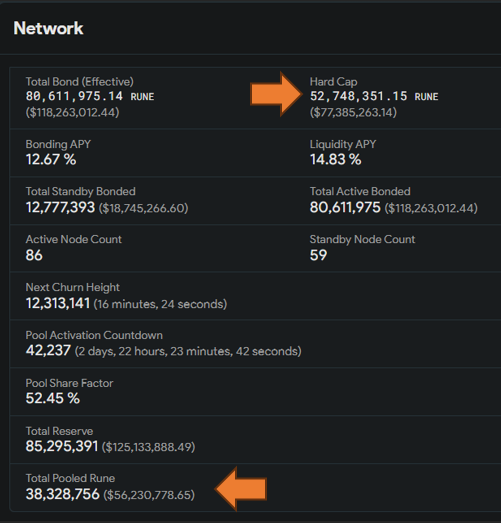
The hard cap is a security measure to ensure nodes are always bonding more than they secure. Specifically, it is the total bonded RUNE of the lowest 67% of active nodes. To elaborate, each active node may be bonding different amounts of RUNE. First, sort the active nodes from most-to-least quantity of RUNE bonded. Then, sum the total RUNE bonded by the lowest 67% of the list: this is the hard cap.
When the total pooled RUNE is higher than the hard cap, swaps, LP/Savers withdrawals and lending still function as normal, but LP/Savers deposits and Synths minting are blocked.
Pooled RUNE can drop back below the hard cap via:
- Overall RUNE:Asset price ratio increases
- Bonded RUNE increases (either by more nodes churning in, or nodes posting more bond)
- Withdrawals from LP/Savers
- Swapping Synths to L1 assets
A way to check if pooled RUNE is higher than the hard cap is via https://thorchain.net/dashboard. Scroll down (on mobile) or lower right panel (on laptop):
2. Savers/Synth Cap
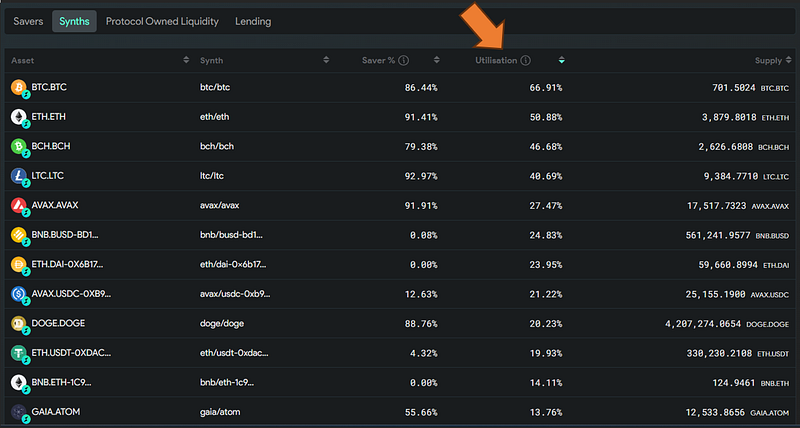
Recap that Savers are held as a Synth position within THORChain, and there is a Savers/Synth Cap for each individual pool. Currently, this is set at 60% of its respective LP depth. This is to prevent over-exposure on the LP to meet the 1:1 redemption of the Savers/Synths.
Once this cap is reached, Savers deposits and Synths minting will be blocked for this specific pool. Savers withdrawals and Synths burning (or swapping the Synths to another asset) are allowed, which will bring the Savers/Synths utilization back below the cap.
Check the current utilization here, at https://thorchain.net/thorfi/synths. Full, or 100% Utilization here represents the maximum Synths allowed (i.e. 60% of LP depth):
3. Overall Lending Cap
The lending cap is a percentage of [burnt RUNE from the maximum supply of 500m]; and is the maximum allowed collateral deposited (priced in RUNE).
This percentage can be set by the Node operators using a Mimir called “Lending Lever” and is currently set at 33%, the initial value used for the launch.
The BEP2/ERC20 RUNE killswitch burnt ~15m RUNE, hence lending cap will start at ~5m RUNE.
Opening of loans will take up some of the lending capacity, but at the same time also burn more RUNE. Conversely, closing of loans will “return” some of the lending capacity, but also mint some RUNE. So the lending cap is dynamic. At the current Lending Lever, the maximum lending cap is around ~7m RUNE.
In terms of allowable quantity of collateral deposited, this will also depend on RUNE:Collateral price ratio. As this ratio increases, more lending space will be created.
Reference lending dashboard: https://dashboards.ninerealms.com/#lending
4. Individual Pool Lending Cap
The total lending cap is then allocated to individual pools (starting with BTC and ETH only) based on individual pool depths, as per https://docs.thorchain.org/thorchain-finance/lending#lending-controls. So each lending pool/collateral has its own individual pool lending cap.
Finally, the Collateralization Ratio (CR) is linearly correlated to the individual pool lending caps, as detailed in https://crypto-university.medium.com/under-the-hood-lending-101-f934e1c22792.
Feel free to hop into the TC University Discord to chat about this, or any other THORChain questions that you may have.
Explore THORChain: Website, X, Telegram, Developer Discord.
Explore Maya Protocol, the first friendly fork of THORChain: Website, X, Discord, Telegram.
Decentralized, permissionless, non-custodial, trust-minimized, open-sourced, economic-secured, non-wrapped, native-to-native cross-chain swaps, savings and now, lending!

Related articles
![How to Swap Crypto on THORChain thumbnail, a THORChain guide]()
Sep. 18, 2026
How to Swap Crypto on THORChain
- Guide
![THORChain Podcast protocol update cover]()
Sep. 17, 2026
THORChain Returns to Shipping: Zcash, Monero and Self-Sufficiency
- Podcast
![NanoGPT and THORChain branding together, representing NanoGPT's accountless AI model marketplace settling crypto payments through THORChain.]()
Sep. 16, 2026
Protocol Spotlight - NanoGPT
- Spotlight
![Thumbnail for THORChain's Investor Relations dashboard on DefiLlama, showing fees, revenue, and income statement charts.]()
Sep. 14, 2026
Introducing THORChain’s DefiLlama Investor Relations Dashboard
- Marketing
![Ecosystem Update Podcast with Station Wallet]()
Sep. 13, 2026
Terra’s Station Wallet Is Back as Vultisig’s Agentic THORChain Wallet
- Podcast
![THORChain Thumbnail for the 2026 guide comparing ten decentralized exchanges across cross-chain support, fees and MEV protection.]()
Sep. 10, 2026
The 10 Best Decentralized Exchanges (DEXs) in 2026
- Guide
![Protocol Update Podcast with Chad Barraford, Kenton and Patriot / Denny]()
Sep. 10, 2026
THORChain Prioritizes Stability Before Monero and New Features
- Podcast
![Thumbnail for THORChain guide explaining how the Advanced Swap Queue and slip-based fees prevent sandwich attacks on swaps.]()
Sep. 7, 2026
How THORChain’s Swap Queue Prevents Sandwich Attacks
- Guide
![Ecosystem Update Podcast with RAVN]()
Sep. 5, 2026
Inside RAVN’s Native $BTC Aggregator and Its THORChain Integration
- Podcast
![State of the Network August 2026 report thumbnail covering THORChain swap volume, fees, active wallets, bonds, Protocol Owned Liquidity, and the affiliate leaderboard.]()
Sep. 4, 2026
State of the Network - August 2026
- Report
![Protocol Update Podcast with Hans, Devel, Chad, Kenton & Denny]()
Sep. 3, 2026
THORChain Churns Again: POL Goes Live, Rujira Resumes and BLO Debate
- Podcast
![THORChain guide thumbnail explaining how to bond RUNE through direct whitelisting, RUNEBond and bRUNE liquid staking, with yield and risk comparisons for each method.]()
Sep. 2, 2026
How to Bond your Rune: a practical guide
- Guide
![THORChain Protocol Spotlight thumbnail for BazaarSwap covering cross-chain aggregation across 360 exchanges, native asset routing and THORChain's role as a core liquidity provider.]()
Aug. 31, 2026
Protocol Spotlight - BazaarSwap
- Spotlight
![Ecosystem Update Podcast with Rujira]()
Aug. 29, 2026
THORChain’s App Layer Rujira Is Paused. Rujira Wants a Clear Restart Path.
- Podcast
![Protocol Update Podcast with Chad Barraford, Kenton and Denny]()
Aug. 27, 2026
THORChain Puts Stability First: Monero & Zcash Delayed, ADR30, AI Agents and Memoless Swaps
- Podcast