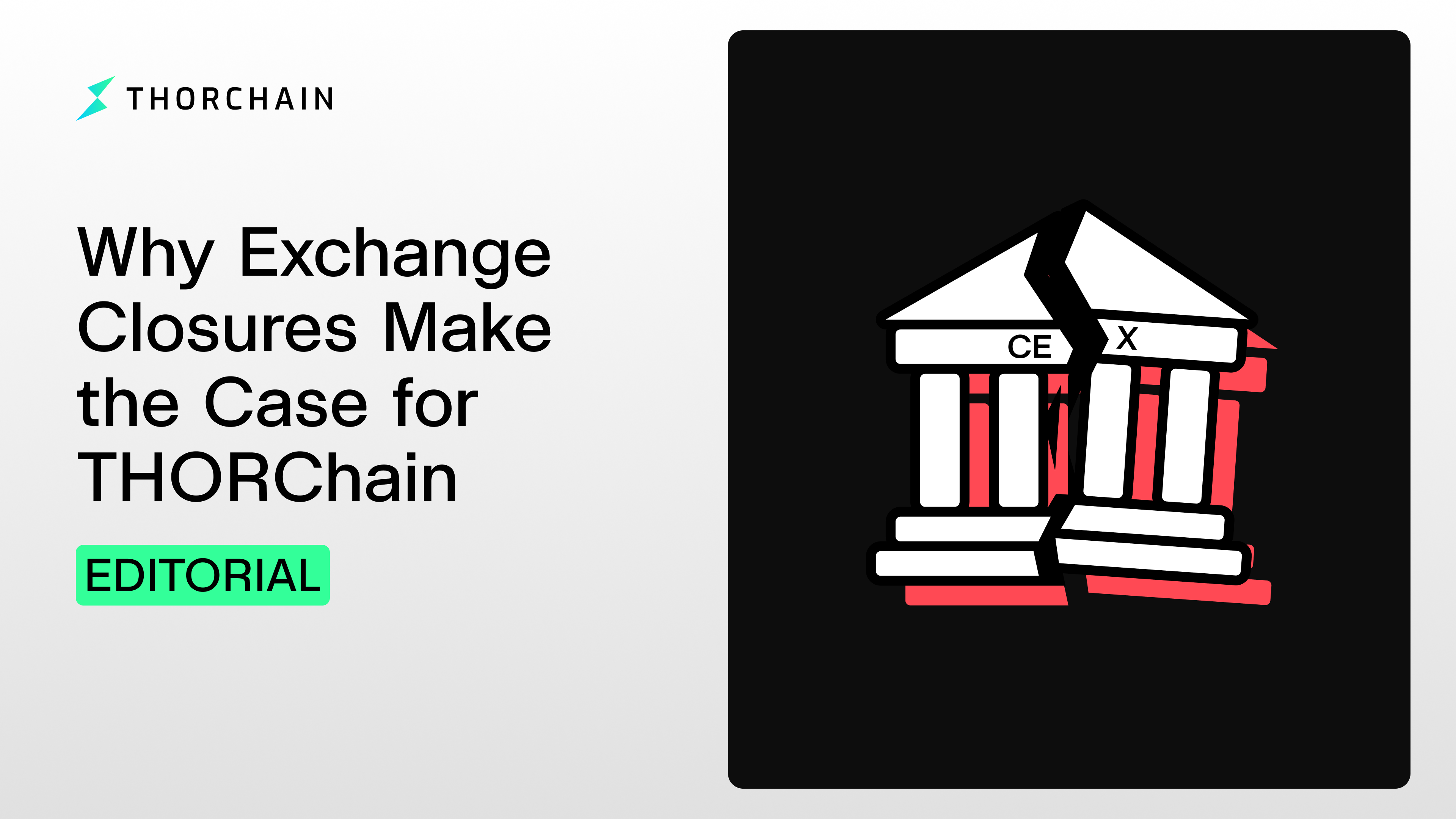
There have been many positive developments in crypto in 2026, but one trend is hard to ignore: several centralized exchanges have shut down or announced plans to close. For their users, an exchange closure is more than a change in trading venue. If their assets are held on the platform, they have to withdraw them on the exchange’s timetable and find somewhere else to keep or trade them.
These closures show why self-custody matters. They also raise a practical question: once users hold their own assets, where can they swap between blockchains without depositing them on another centralized exchange? THORChain offers a way to do that.
Why Are Centralized Exchanges Shutting Down?
One of the main reasons centralized exchanges shut down is cost. Running an exchange requires significant spending on compliance, legal, security, customer support, and day-to-day operations.
Regulation adds another layer. Industry estimates put the first-year cost of becoming MiCA-compliant at around €300,000 to €700,000 for a Class 2 or Class 3 crypto service provider, with ongoing costs of roughly €150,000 to €250,000 per year. For the largest exchanges, these expenses are manageable. For smaller and mid-sized platforms, however, they can put much more pressure on the business.
That pressure gets even stronger as competition between exchanges increases. In a volatile market where trading volumes can slow down quickly, it can be difficult to maintain a positive balance sheet, especially when many of these costs don’t go away.
Exchange | Closure date or deadline | Reported users | Reason given |
|---|---|---|---|
AscendEX | Ceased operations on 1 July 2026 | Over 1 million | Cited its lack of EU MiCA authorisation, alongside wider regulatory, financial and operational difficulties. |
BitMart | Ended trading on 26 August 2026; planned platform closure on 31 January 2027 | Over 13 million | Cited its operating conditions, the market environment and its future strategy. It has since discussed a possible restructuring and resumption of business. |
BitMEX | Closed on 23 September 2026 | Over 2 million traders | Said its board made the decision after reviewing the business and the wider crypto industry. It did not give a more specific public reason. |
CoinEx | Winding down; users have until 22 December 2026 to withdraw | Over 10 million registered users | Cited falling trading volume and liquidity, rising regulatory requirements, compliance costs, and operational uncertainty. |
For people who use these exchanges, that means finding a new home for their crypto. A planned closure can force them to move their assets by a deadline. In the worst-case scenario, users may even have to wait to get their assets back if an exchange is unable to fullfil all withdrawals.
How THORChain Lets You Trade Without Relying on an Exchange
When a centralized exchange shuts down, users don’t necessarily need to move their assets to another exchange. They can move into self-custody instead, where they control their own funds and don’t depend on a company to keep them accessible.
The challenge comes when they want to trade. Cross-chain swaps have traditionally pushed users back toward centralized exchanges because moving from an asset like ETH into BTC often means depositing funds on a platform, making the trade, and withdrawing again.
THORChain gives users another way to trade. They can keep their assets in self-custody and still swap between native assets across different blockchains.
THORChain also doesn’t require KYC. There’s no account to open, no identification to submit, no proof of address, and no enhanced due diligence before making a swap. Users can connect a self-custody wallet and access the protocol directly.
This lets users stay in control of their assets while still accessing cross-chain liquidity when they want to trade.
CEXs are Closing. Onchain is the Alternative
A centralized exchange shutting down doesn’t mean users have to find another centralized exchange. The solution can be much simpler and closer to what crypto was originally built for: self-custody, freedom of money, and transparency.
That’s where THORChain comes in. Users keep control of their own assets while still being able to swap across blockchains. They don’t have to hand custody to a company or depend on a centralized platform staying open.
Using THORChain means keeping sovereignty over your money while reducing the counterparty risk that comes with storing and trading assets through a centralized exchange.
Start swapping on swap.thorchain.org

Related articles
![THORChain article thumbnail explaining how the protocol distributes control between developers and nodes, and what meaningful decentralization looks like in practice.]()
Aug. 11, 2026
What Makes THORChain Decentralized
- Editorial
![THORChain article thumbnail explaining how THORChain expands native Bitcoin utility through permissionless cross-chain swaps without custodians or wrapped tokens.]()
Jul. 16, 2026
The Role of THORChain in Expanding Bitcoin Utility
- Editorial
![]()
May. 13, 2026
The Casino Problem: When Crypto Forgets What It Was Built For
- Editorial
![]()
Mar. 20, 2026
Tokenisation, RWAs, and the Future of THORChain
- Editorial
![]()
Jan. 22, 2026
When Your Money Is Not Really Yours
- Editorial
![]()
Nov. 28, 2025
The Trustless Manifesto: Why THORChain Is Structurally Different
- Editorial
![]()
Jul. 1, 2025
Op-Ed: The Case for Repurposing THORChain’s Burn
- Editorial
![]()
Apr. 23, 2025
Op-Ed: THORChain’s Security Design Probably Needs to Change
- Editorial
![]()
Feb. 24, 2025
Op-Ed: The Bull Case for THORChain, $RUNE, and $TCY
- Editorial
![]()
Jan. 28, 2025
Op-Ed: The Case for THORChain Suspending Block Rewards
- Editorial
![]()
Dec. 18, 2024
Op-Ed: An Independent Analysis of THORChain Tokenomics
- Editorial
![]()
Nov. 7, 2024
Op-Ed: The Case for Savers to be Sunset
- Editorial
![]()
Jul. 6, 2024
Ruminations: Descriptors of THORChain
- Editorial
![]()
May. 22, 2023
Ruminations: On Decentralization
- Editorial
![]()
Jan. 19, 2023
THORChain 2023 Look Ahead
- Editorial