How does THORChain stack up to other decentralized exchanges? Part 2.

2018-11-14 — 6 min read
Siloed technology does not make sense.
Crypto markets have a liquidity problem.
The tokenized landscape is littered with disruptive ideas and technologies, yet dysfunctionally hamstrung by fragmented, albeit loyal, tribes and repositories of siloed focus and commitment. Much like different religious and ideological groups.
Even though these groups share much in common, the small differences that they do not agree to create enormous derision due to the passionate nature of their belief.
Uniting these tribes by bridging technologies and pools of liquidity is the key to creating a better market for everyone.
This is because one of the easiest ways to solve the liquidity problem is by sharing it.
THORChain is a decentralized exchange protocol that is designed to solve cryptos biggest problem and create a continuously liquid, decentralized market.
Continuing on from Part 1 we will look into the need for validators on THORChain, staking, on-chain governance, analysis of incentives (in their different forms) and a direct comparison to other decentralized exchange solutions being proposed.
Validators on THORChain
THORChain will deploy Tendermint, which is the software of the Cosmos blockchain, as the consensus mechanism of the protocol.
Tendermint distributes the state of something across the globe without any central authority. This distribution of information can be anything. It can be a ledger, a database of pictures, or even a list of unresolved trade orders.
Cosmos is built with Tendermint and it is a Proof-of-Stake coin that uses delegation to allow anyone, even non-validators to participate in staking.
Tendermint requires full-nodes as Validators or block producers, and each Validator must have a weight on the network. The weight is determined by their staking, so Tendermint can support Proof-of-Stake out of the box.
Staking
Staking is an inherent and important part of the protocol and provides liquidity to all assets. Due to the way that CLPs are created alongside the instantiation of digital assets on THORChain, there will always be some liquidity depth to assets. By adding incentivization (liquidity fees), trading pairs will always be liquid, increasing the usefulness and value of the protocol.
When staking, a user can stake symmetrically or asymmetrically in the pool. Despite the method of staking, the user will always end up receiving assets on both sides of the pool.
The reasons for this are twofold:
By receiving assets on both sides of the pool the staker is hedged against any downside on one side and thus any fees earned presents a net gain in value to the staker.
Staking asymmetrically creates a price imbalance that is corrected by either arbitrage or market forces, and thus results in an accumulation of assets on the unbalanced side for the staker.
On-Chain Governance
Distributed public ledgers should have a constitution and a governance system. No other decentralized exchange, either realized or proposed, includes on-chain governance. This is a significant separation in architecture from other DEXs.
The reason THORChain requires on-chain governance is to allow a smooth path for upgrades as validators are required to maintain the protocol, with tasks that include:
- adding new bridges
- protocol upgrades
- resolving issues around bridges from re-orgs or hard forks
All other validators vote to accept the change and if it reaches supermajority consensus the updated code can be immediately brought in to operation. The proposing and agreeing validators run the compiled core software on standby, so that once approved, the core software is live to produce the very next block. The types of updates that can be rolled out are essentially unlimited and could be:
Consensus rules such as supermajority thresholds, or voting rules (relating to on-chain governance itself)
Protocol architecture such as a change to consensus algorithms, integration of sharding, change to the blockchain structure or signature schemes.
Native on-chain commands as discussed, whereby additional trading rules can be integrated at the protocol level.
Changes to the token structure such as supply or inflation.
Changes to state, such as amending exploited or unused accounts.
A key aspect of this is Economically Enforced Participation. Voter participation is enforced by in-protocol slashing rules. Not voting on a proposed update or poll will result in a Validator’s stake being slashed and redistributed to other Validators who do vote.
There is a grace period of n blocks allowing Validators time to poll the community (or their staking pool) and take up a position before casting a vote.
Analysis of Incentives
THORChain incentivizes every agent in the network to add value and be economically rewarded. The following are the agents and their incentives:
- Stake liquidity in pools and be rewarded on liquidity fees.
- Arbitrage across markets and earn on price discovery.
- Build an exchange or wallet and add maker/taker fees.
- Run a Validator and earn on block rewards.
Staking Liquidity
The simplest contribution anyone can make is to simply stake liquidity in pools. The value of their liquidity is always protected, they always earn on volume and their assets are always self-sovereign. Staking will be so simple, that it can be performed directly from wallets and a simple on-chain transaction is required to stake-in, stake-out or withdraw earnings.
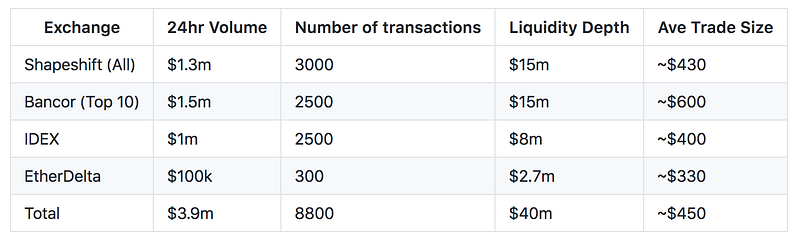
The following is an analysis of the expected returns for staking from real-world data (missing data is extrapolated based on trade sizes and spreads), sampled in Q3 2018.
Developer Incentives
In order to attract a wide variety of developers and businesses to build on the infrastructure and provide the tools for arbitrage and traders, there are three sources of potential revenue:
Protocol-level incentives as maker/taker fees.
Stake assets on behalf of users and earn liquidity fees.
Arbitrage across markets using exchange infrastructure and existing liquidity.
Liquidity and arbitrage fees are entirely dependent on the wider market, but the optional maker/taker fees would create a price-competitive environment and would tend to zero. Staffed exchange interfaces would have no liquidity or feature advantage over staff-less exchange interfaces, so they would need to continually improve customer service and user experience to win users.
Summary and continuation
THORChain will use Tendermint as the mechanism for consensus. Tendermint requires validators, and each validator must be staked to the protocol in the form of Rune (native currency of THORChain).
The validator set will make up the quorum for on-chain governance to allow a smooth path for upgrades as validators are required to maintain the protocol. As far as we are aware no other DEX solution makes use of on-chain governance to reach consensus on protocol maintenance and upgrades.
THORChain is also the first decentralized exchange that will incentivize liquidity, to create continuously liquid markets and aim to solve the biggest issues in crypto today.
In the next article we will compare the THORChain protocol to all existing DEX solutions on a feature level.

Related articles
![How to Swap Crypto on THORChain thumbnail, a THORChain guide]()
Sep. 18, 2026
How to Swap Crypto on THORChain
- Guide
![THORChain Podcast protocol update cover]()
Sep. 17, 2026
THORChain Returns to Shipping: Zcash, Monero and Self-Sufficiency
- Podcast
![NanoGPT and THORChain branding together, representing NanoGPT's accountless AI model marketplace settling crypto payments through THORChain.]()
Sep. 16, 2026
Protocol Spotlight - NanoGPT
- Spotlight
![Thumbnail for THORChain's Investor Relations dashboard on DefiLlama, showing fees, revenue, and income statement charts.]()
Sep. 14, 2026
Introducing THORChain’s DefiLlama Investor Relations Dashboard
- Marketing
![Ecosystem Update Podcast with Station Wallet]()
Sep. 13, 2026
Terra’s Station Wallet Is Back as Vultisig’s Agentic THORChain Wallet
- Podcast
![THORChain Thumbnail for the 2026 guide comparing ten decentralized exchanges across cross-chain support, fees and MEV protection.]()
Sep. 10, 2026
The 10 Best Decentralized Exchanges (DEXs) in 2026
- Guide
![Protocol Update Podcast with Chad Barraford, Kenton and Patriot / Denny]()
Sep. 10, 2026
THORChain Prioritizes Stability Before Monero and New Features
- Podcast
![Thumbnail for THORChain guide explaining how the Advanced Swap Queue and slip-based fees prevent sandwich attacks on swaps.]()
Sep. 7, 2026
How THORChain’s Swap Queue Prevents Sandwich Attacks
- Guide
![Ecosystem Update Podcast with RAVN]()
Sep. 5, 2026
Inside RAVN’s Native $BTC Aggregator and Its THORChain Integration
- Podcast
![State of the Network August 2026 report thumbnail covering THORChain swap volume, fees, active wallets, bonds, Protocol Owned Liquidity, and the affiliate leaderboard.]()
Sep. 4, 2026
State of the Network - August 2026
- Report
![Protocol Update Podcast with Hans, Devel, Chad, Kenton & Denny]()
Sep. 3, 2026
THORChain Churns Again: POL Goes Live, Rujira Resumes and BLO Debate
- Podcast
![THORChain guide thumbnail explaining how to bond RUNE through direct whitelisting, RUNEBond and bRUNE liquid staking, with yield and risk comparisons for each method.]()
Sep. 2, 2026
How to Bond your Rune: a practical guide
- Guide
![THORChain Protocol Spotlight thumbnail for BazaarSwap covering cross-chain aggregation across 360 exchanges, native asset routing and THORChain's role as a core liquidity provider.]()
Aug. 31, 2026
Protocol Spotlight - BazaarSwap
- Spotlight
![Ecosystem Update Podcast with Rujira]()
Aug. 29, 2026
THORChain’s App Layer Rujira Is Paused. Rujira Wants a Clear Restart Path.
- Podcast
![Protocol Update Podcast with Chad Barraford, Kenton and Denny]()
Aug. 27, 2026
THORChain Puts Stability First: Monero & Zcash Delayed, ADR30, AI Agents and Memoless Swaps
- Podcast