Bonding RUNE helps secure THORChain and allows node operators and their bond providers to earn a share of the network's rewards. However, there's been one limitation for bond providers: accessing those rewards generally means waiting until their node churns out of the active validator set.
Until then, rewards are automatically added to their bond, increasing the amount securing the network and contributing to future earnings. That's useful for providers who want to compound their rewards, but not everyone wants to keep reinvesting their earnings. Some would prefer to receive a portion as regular income while keeping their existing bond intact.
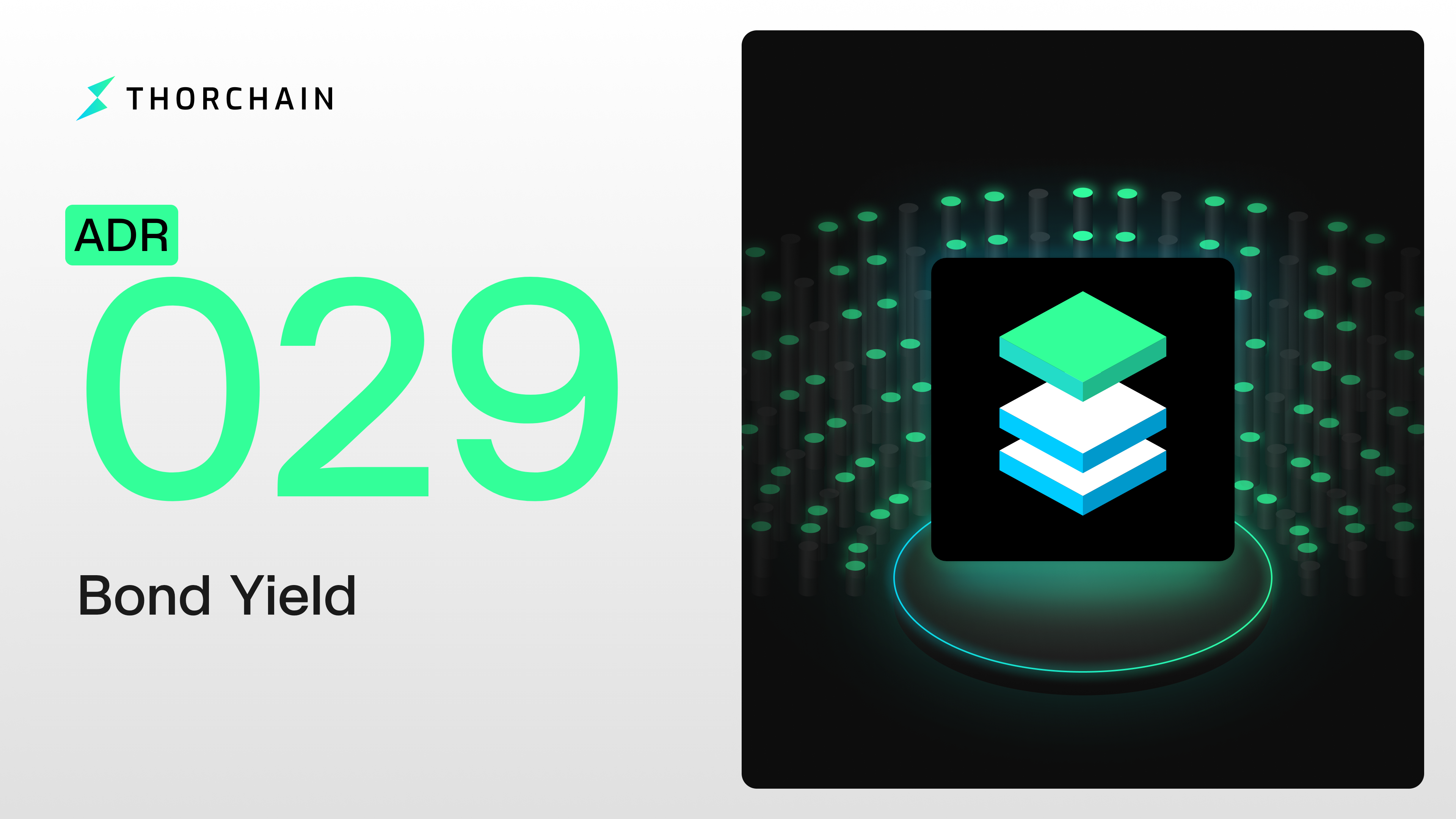
ADR-029 introduces Streaming Yield, also called Bond Yield in the protocol, giving bond providers the option to automatically receive a percentage of their future rewards while the rest continues compounding into their bond.
How bond rewards worked before ADR-029
THORChain relies on validators to observe transactions, sign outbounds, and secure the network. These validators bond RUNE as collateral, which can come from the node operators themselves or from independent bond providers who contribute RUNE to help secure a node.
In return, validators earn bond rewards that are shared between the operator and their bond providers. The node operator takes a fee first, after which the remaining rewards are distributed among bond providers according to their share of the node's bond.
Previously, those rewards were automatically added to each provider's bonded RUNE. For example, if someone had 100,000 RUNE bonded and earned another 1,000 RUNE in rewards, their bond would increase to 101,000 RUNE. Those additional rewards would then contribute to their share of future earnings.
The problem was that bond providers couldn't access those rewards immediately. They generally had to wait until their node churned out of the active validator set before they could unbond and withdraw their earnings. Churning is the process through which THORChain rotates validators in and out of the active set, typically occurring around every three days.
For anyone looking to earn regular income from their bonded RUNE, this meant depending on the validator rotation process to access their rewards.
What ADR-029 changes
ADR-029 introduces a way for bond providers to automatically receive part or all of their future rewards without withdrawing their existing bond.
Each provider can configure a payout percentage that determines how much of their rewards are sent to their wallet and how much is automatically added to their bond. The percentage is expressed in basis points, with 10,000 bps representing 100%.
Whenever THORChain distributes validator rewards, the node operator's fee is deducted first. The remaining rewards are allocated among the bond providers, and each provider's chosen percentage is paid out automatically. Whatever isn't paid out is added to their bond as usual.
Consider a provider with 100,000 RUNE bonded who receives an allocation of 1,000 RUNE in rewards. Under the previous system, all 1,000 RUNE would be added to their bond, increasing it to 101,000 RUNE. With Streaming Yield configured at 30%, the provider instead receives 300 RUNE directly, while the remaining 700 RUNE is rebonded. Their bond increases to 100,700 RUNE, and they've received 300 RUNE without withdrawing any of their existing bond.
Payout options and rollout
Bond providers can also choose where their rewards are sent. By default, payouts are made in native RUNE to the provider's own address, but they can configure another THORChain address or a THORName they own as the destination.
Using a THORName introduces another option. If the THORName has a preferred asset configured, payouts can be processed through THORChain's existing Affiliate Collector system, which supports converting the received RUNE into that asset.
For example, a provider who prefers to receive BTC could configure a THORName with BTC as its preferred asset. Their RUNE rewards would then be routed through the existing system for conversion, provided the necessary swap route is available.
The mechanism also includes safeguards to prevent failed payouts from affecting a provider's rewards. If a payout can't be completed, THORChain automatically adds that amount back to the provider's bond instead. Ownership of any configured THORName is also verified to ensure that providers can only direct payouts through THORNames they control.
Streaming Yield is optional and controlled by the BondYieldEnabled Mimir parameter. When the feature is disabled, or a provider hasn't configured a payout percentage, all rewards continue to be rebonded as before. Providers can also turn off their automatic payouts at any time by setting their percentage back to zero.
Conclusion
ADR-029 removes an inconvenience for bond providers who want to earn income from their RUNE without having to wait for their validator to churn out.
They'll be able to choose how much of their future rewards they receive and how much they continue reinvesting into their bond. Those who prefer to compound their earnings can keep doing exactly that, while providers who want regular payouts will have an option that doesn't require withdrawing their existing bond.
The change could also make THORChain bonding more appealing to participants who want to use their RUNE holdings to generate income, especially with the option to receive rewards through a THORName configured for another asset.

Related articles
![THORChain cover with "Private Swaps" in a cyan-to-green gradient, "Powered by Houdini" and "Now live on swap.thorchain.org", next to the purple Houdini logo in a gradient ring on a dark background.]()
Oct. 30, 2026
Private Swaps and Sends are Live on swap.thorchain.org, Powered by Houdini
- Guide
![How to get TCY on THORChain: A Step-by-Step Guide.]()
Oct. 27, 2026
How to Get TCY on THORChain: A Step-by-Step Guide
- Guide
![A mint green notification bell glyph on a black key, cover of THORChain's guide to its official channels, podcasts and social media.]()
Oct. 9, 2026
How to Stay Up to Date With THORChain
- Guide
![Zcash (ZEC) logo alongside the THORChain logo, illustrating native ZEC swaps across blockchains on THORChain.]()
Oct. 7, 2026
Bringing Native Zcash to THORChain
- Guide
![boone.tools logo on a dark THORChain background, introducing Boone's collection of THORChain analytics dashboards.]()
Oct. 5, 2026
Introducing boone.tools: A Better Way to Understand THORChain
- Spotlight
- Guide
![THORChain's System Income distribution, with 20% now directed to Protocol-Owned Liquidity and the RUNE burn reduced to 1%.]()
Sep. 23, 2026
How THORChain’s New System Income Distribution Works
- Guide
![Illustration of THORChain's Protocol-Owned Liquidity system, showing System Income flowing into deeper liquidity pools.]()
Sep. 21, 2026
Why Protocol-Owned Liquidity Matters for THORChain
- Guide
![How to Swap Crypto on THORChain thumbnail, a THORChain guide]()
Sep. 18, 2026
How to Swap Crypto on THORChain
- Guide
![THORChain Thumbnail for the 2026 guide comparing ten decentralized exchanges across cross-chain support, fees and MEV protection.]()
Sep. 10, 2026
The 10 Best Decentralized Exchanges (DEXs) in 2026
- Guide
![Thumbnail for THORChain guide explaining how the Advanced Swap Queue and slip-based fees prevent sandwich attacks on swaps.]()
Sep. 7, 2026
How THORChain’s Swap Queue Prevents Sandwich Attacks
- Guide
![THORChain guide thumbnail explaining how to bond RUNE through direct whitelisting, RUNEBond and bRUNE liquid staking, with yield and risk comparisons for each method.]()
Sep. 2, 2026
How to Bond your Rune: a practical guide
- Guide
![THORChain guide thumbnail showing how to perform a cross-chain swap without connecting a wallet, using the Walletless Swap feature on swap.thorchain.org.]()
Aug. 12, 2026
How To: Walletless Swaps
- Guide
![THORChain is transparent even with privacy coins thumbnail.]()
Jul. 21, 2026
THORChain Is Transparent Even With Privacy Coins
- Guide
![THORChain Community Podcast #198 thumbnail featuring JP and Kenton demonstrating the first live decentralised RUNE to Monero swap on THORChain's chainnet.]()
May. 14, 2026
JP Demos Live Monero on THORChain: 7 Nodes, Real Funds, First Swap Works
- Podcast
- Guide
![]()
Apr. 22, 2026
How to read a transaction on THORChain?
- Guide