Edit: On 24-Sept-2024, new loans can no longer be opened. Existing loans are fine and continue to be redeemable anytime.
THORChain Lending design is revolutionary, with a flat 200% collateralization ratio (or 50% loan-to-value, LTV), zero expiry, zero liquidity and zero interest (outside of slippage when opening or closing loans).
This revolutionary tech begets many questions:
Who provides the assets that are borrowed?
Who keeps the collateral?
What happens when collateral value drops?
Who is the counterparty?
What are the risks?
Are there other considerations I should be aware of?
It’s helpful here to forget any presumptions about lending, especially from a traditional finance point of view, and try to think through THORChain’s lending design from a “first principles perspective”.
Example
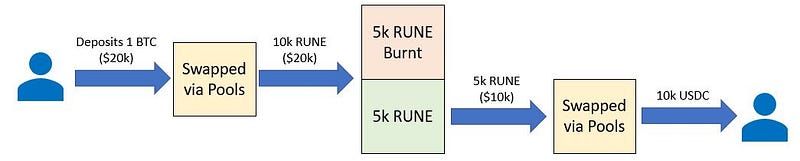
Let’s immediately jump into an example of a loan opening and closing (with below notes):
- Below examples neglect slippage and inbound/outbound gas fees
- Collateral is L1 native assets only, e.g. BTC, ETH
- Debt issued & repayment can be in any assets on THORChain, but accounted in USD value, based on internal TOR accounting unit
Loan Opening
Assuming:
- 1 BTC = $20k
- 1 RUNE = $2
Loan Closing
Assuming:
- 1 BTC = $100k
- 1 RUNE = $20
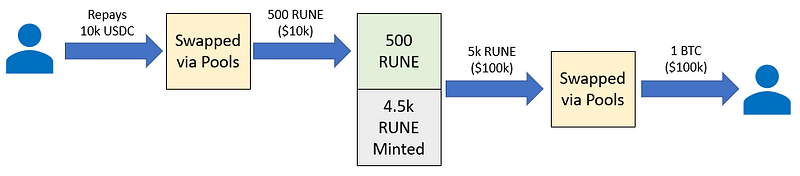
From the above schematics, let’s answer the above questions:
Who provides the assets which are borrowed?
RUNE is swapped to the borrowed asset via the liquidity pools, then sent to the borrower. Therefore, as long as the pool is available, there are always assets available to be borrowed. The deeper the pool depth, the less slippage incurred.
Remember, the pools are somewhat independent to lending. As long as the pools are healthy and functioning, any assets which are withdrawn via lending will simply lead to arbers rebalancing the pools as usual.
2. Who keeps the collateral?
The collateral is swapped to RUNE via the pools. So, nobody “keeps” the collateral. Again, as long as the pools are healthy and functioning, any collateral which is deposited will simply lead to arbers rebalancing the pools as usual.
3. What happens when collateral value drops?
Since nobody “keeps” the collateral (i.e. it has already been swapped through the pools at the moment of loan opening), THORChain does not care, nor is under any risk if collateral value drops. This is how a zero liquidation design can be achieved.
4. Who is the counterparty?
Here is probably the crux of the whole lending design. Due to the RUNE burning/minting mechanism, it is actually all the RUNE holders which are collectively the counterparty to the borrowers. Burning/minting can be framed as concentrating/diluting the value among the rest of the RUNE holders.
Opening loans burn RUNE, and thus accrues value to all the RUNE holders. Conversely, the same RUNE holders are liable/exposed to minting of RUNE when loans are closed.
Another way to frame this is that the whole THORChain protocol is underwriting the loans. As long as RUNE has value, the lending mechanics can work as intended.
5. What are the risks?
This is the most hotly debated aspect of THORChain lending and it is not the intention of this article to give an exhaustive treatise on this topic. However, we will address some of the major public concerns. The obvious risk is the excessive minting of RUNE from total loan closures vs loan openings.
For a single loan opening/closing cycle, yes, a net minting of RUNE may occur if the RUNE:collateral price ratio decreases between loan opening vs loan closure. However, it is not single loans that THORChain is concerned about, but the overall status of RUNE mint/burnt.
It could also happen that net minting of RUNE occurs if ALL loans were closed at the same time (hence why there is a minimum 30 day loan period). The question is: will all borrowers close their loans at the same time? Some could have borrowed for actual expense needs (thus no ready cash to immediately repay).
So the idea is that the net of all loan closings (which logically must always be less than, or at most, same as all openings) versus all openings, at the RUNE:collateral price at each individual opening/closing, is likely net burning RUNE.
If minting does actually cause the total supply to exceed the Maximum Total Supply (Hard Cap Limit), the Reserves will step in to redeem the loans (instead of further minting), and the other aspects of THORChain will continue as usual.
The absolute worst-case scenario is when even the Reserves are depleted trying to repay collateral. In this case, a circuit breaker will be triggered, and the whole THORChain lending module will be suspended.
All this said, there are still other factors in place to moderate these risks, such as the lending cap and the expected positive price impact from the RUNE burning mechanism (from loan openings). For a deeper analysis, please read through the Block Science Risk Report (link below).
6. Other Considerations/Details
- When a loan is opened, the full debt (at 200% collateralization ratio) will be issued. If the price of collateral increased, there is no option to request additional debt. To acquire more debt, a user must repay the original debt, redeem the collateral fully, then reopen a fresh loan.
- The same address (with an existing loan position) can open a new loan by depositing fresh collateral — new debt will be issued based on the new collateral amount only.
- Collateral is not returned until the full debt is repaid. Partial debt repayment can be made, but no partial collateral will be returned. If the same address opened multiple loans, the totality of all the debt must be repaid, before the full collateral is then returned.
- Minimum loan period is 30 days (Mimir controlled).
Resources:
- Intro/summary video: Lending Essentials, Workings & Risks: https://youtu.be/AaqHG00RJks
- Lending Docs: https://docs.thorchain.org/thorchain-finance/lending
- ADR 011: https://gitlab.com/thorchain/thornode/-/blob/develop/docs/architecture/adr-011-lending.md
- Block Science Risk Report: https://hackmd.io/@blockscience/H1Q-erh_n/%2F_Btk5G8-Tn27RJfbdgecyQ
Feel free to hop into the TC University Discord to chat about this, or any other THORChain questions that you may have.
Explore THORChain: Website, X, Telegram, Developer Discord.
Explore Maya Protocol, the first friendly fork of THORChain: Website, X, Discord, Telegram.
Decentralized, permissionless, non-custodial, trust-minimized, open-sourced, economic-secured, non-wrapped, native-to-native cross-chain swaps, savings and now, lending!

Related articles
![How to Swap Crypto on THORChain thumbnail, a THORChain guide]()
Sep. 18, 2026
How to Swap Crypto on THORChain
- Guide
![THORChain Podcast protocol update cover]()
Sep. 17, 2026
THORChain Returns to Shipping: Zcash, Monero and Self-Sufficiency
- Podcast
![NanoGPT and THORChain branding together, representing NanoGPT's accountless AI model marketplace settling crypto payments through THORChain.]()
Sep. 16, 2026
Protocol Spotlight - NanoGPT
- Spotlight
![Thumbnail for THORChain's Investor Relations dashboard on DefiLlama, showing fees, revenue, and income statement charts.]()
Sep. 14, 2026
Introducing THORChain’s DefiLlama Investor Relations Dashboard
- Marketing
![Ecosystem Update Podcast with Station Wallet]()
Sep. 13, 2026
Terra’s Station Wallet Is Back as Vultisig’s Agentic THORChain Wallet
- Podcast
![THORChain Thumbnail for the 2026 guide comparing ten decentralized exchanges across cross-chain support, fees and MEV protection.]()
Sep. 10, 2026
The 10 Best Decentralized Exchanges (DEXs) in 2026
- Guide
![Protocol Update Podcast with Chad Barraford, Kenton and Patriot / Denny]()
Sep. 10, 2026
THORChain Prioritizes Stability Before Monero and New Features
- Podcast
![Thumbnail for THORChain guide explaining how the Advanced Swap Queue and slip-based fees prevent sandwich attacks on swaps.]()
Sep. 7, 2026
How THORChain’s Swap Queue Prevents Sandwich Attacks
- Guide
![Ecosystem Update Podcast with RAVN]()
Sep. 5, 2026
Inside RAVN’s Native $BTC Aggregator and Its THORChain Integration
- Podcast
![State of the Network August 2026 report thumbnail covering THORChain swap volume, fees, active wallets, bonds, Protocol Owned Liquidity, and the affiliate leaderboard.]()
Sep. 4, 2026
State of the Network - August 2026
- Report
![Protocol Update Podcast with Hans, Devel, Chad, Kenton & Denny]()
Sep. 3, 2026
THORChain Churns Again: POL Goes Live, Rujira Resumes and BLO Debate
- Podcast
![THORChain guide thumbnail explaining how to bond RUNE through direct whitelisting, RUNEBond and bRUNE liquid staking, with yield and risk comparisons for each method.]()
Sep. 2, 2026
How to Bond your Rune: a practical guide
- Guide
![THORChain Protocol Spotlight thumbnail for BazaarSwap covering cross-chain aggregation across 360 exchanges, native asset routing and THORChain's role as a core liquidity provider.]()
Aug. 31, 2026
Protocol Spotlight - BazaarSwap
- Spotlight
![Ecosystem Update Podcast with Rujira]()
Aug. 29, 2026
THORChain’s App Layer Rujira Is Paused. Rujira Wants a Clear Restart Path.
- Podcast
![Protocol Update Podcast with Chad Barraford, Kenton and Denny]()
Aug. 27, 2026
THORChain Puts Stability First: Monero & Zcash Delayed, ADR30, AI Agents and Memoless Swaps
- Podcast